
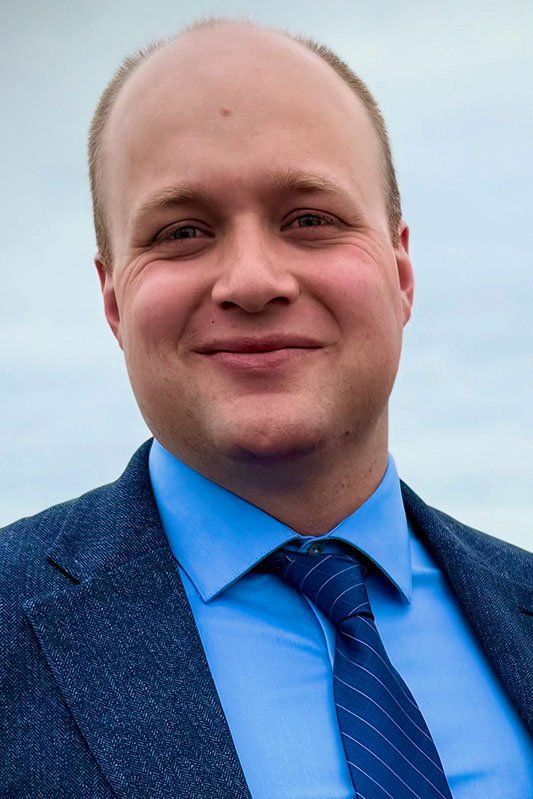
Rick Lindfors-Ackerman
This Spotlight appeared in our February 2026 newsletter.
Please introduce yourself and tell us how you got connected to the Foundation.
I’m Rick Lindfors-Ackerman and I have VWD-3. I was connected to the Foundation through my local hemophilia treatment center. I wanted to meet more people within the bleeding disorders community, share experiences, and connect with providers and treatment developers. I work a day job in my family’s manufacturing business and spend my free time working out, volunteering, adventuring with my wife Kayla, working on our house, and teaching snowboarding.
Where do you live? What’s a special spot you would take a visitor? We like to hear from the locals!
I live in the Minneapolis area. It’s a lovely city and a foodie’s paradise. If you had one day in Minneapolis I’d recommend kayaking on Lake Minnetonka during the day, eating at a restaurant in the north loop then walking over to the Acme Comedy Club for some good laughs. If it’s the winter, we’d go snowboarding. If you don’t know how, I can teach you! If you’d prefer to stay in, there are a number of wonderful art cultural museums. Of course, there’s the state fair in the summer where any food you can imagine is deep fried to perfection.
We were sorry you couldn’t come to last summer’s conference. Hypothetically, if you HAD gone, what would’ve been your favorite part?
I would have loved to connect with more people and hear their experiences. I love the unspoken understanding that comes with being connected in the rare disease community.
What has your journey been like with sVWD up to now?
There has been plenty of chaos and learning. As a kid I played a lot of sports including tennis, snowboarding, and lacrosse. My family learned quickly how to structure treatment and medications around our activities. I played goalie in lacrosse so having pan-sized welts on my legs was pretty common. Nosebleeds were common in the dry, bitter Minnesota winters. Also I was raised in a very outdoorsy family and spent several summers backpacking and canoeing across the U.S. and Canada. I had two trips where VWD-related issues resulted in me needing to self-evacuate for additional medicine or medical care before being able to complete those trips. My family also navigated several surgeries and recoveries growing up, which teaches you a lot about being patient and listening to your body.
As an adult I’m learning more about aging with a bleeding disorder as well as wading through the ever-changing healthcare landscape. My wife is an insurance agent and a tremendous advocate, so she’s able to cut through a lot of the policy language when we’re reviewing plans and networks.
What resources have you drawn on the most during your life that have helped you? Could be other people, hobbies, mantras, inner strength, anything at all!
I’m a gym rat and staying in shape helps me keep up with the physical demands of snowboarding, outdoor activities, home improvement, and volunteering in search and rescue. I’m a fan of weightlifting, CrossFit, swimming and – believe it or not – yoga. All of it is to keep my body durable and reduce the risk of injury from my favorite activities. The metrics and tangible improvements from those activities (i.e. lifting heavier and better flexibility) provide confidence and assurance when doing things that pose a bleed risk.
I also had excellent care teams at my HTC in Minneapolis while growing up. All of them were focused on finding ways for our family to do everything we wanted to. There weren’t many occasions where I avoided something because of von Willebrand disease. Coming back home to Minnesota has allowed me to reconnect with some of those care providers and it’s been a wonderful experience.
Please tell us about your involvement with search and rescue, and when you started.
I started volunteering in search and rescue in 2015 in Eugene, Oregon. I heard about the local sheriff’s team while working in TV news. I know what it’s like to be on the “receiving end” of a wilderness medical emergency and figured this would be the right way to give back to the community with my outdoor skill sets. I was part of mountain rescue, K9, and water support teams and did disaster relief for winter storms and wildfires. Our team also supported the local health department during the COVID-19 pandemic, which played a role in easing economic restrictions. I also worked as the editor in chief of the Mountain Rescue Association’s quarterly mission and medical publication for four years providing in-depth coverage of SAR missions, profiles of team members, and medical case reports.
I got into K9 work after a few years of training alongside K9 handlers and encountering teams from other sheriff’s offices. On one mission, I was able to walk back to a staging point alongside a handler and talk to him for a while about his dog and training. They looked like they were having a blast working together and figured I should give it a shot once I stopped working overnights. A few years later I was working during the daytime and started training with my first dog, K9 Ellie. Even though she was middle aged, she loved the work! We were able to certify as a wilderness air scent team before moving back home to Minnesota.
I’m currently a handler with the Minnesota Search and Rescue Dog Association, a volunteer group that provides K9 teams to help law enforcement with missing persons investigations. It’s an excellent group of people from a variety of professional backgrounds. Everyone brings something to the table that makes our team better. My current dog, K9 Koosah, is certified in trailing, and training for a second certification in human remains detection. K9 Ellie is now happily retired.
What has this work this brought to your life?
I’ve met so many cool people through search and rescue. The SAR community is chock-full of ingenious volunteer professionals who commit so much to saving lives. These men and women climb mountains, descend into volcanic gas vents, ratchet boulders off people, hoist from military helicopters, and solve complex missing person cases all while never earning a dime. I’ve also interviewed people who were rescued by SAR teams and came to understand the full-circle effect that public service has.
It’s also made me more disciplined. Being a first responder means staying in shape like someone else’s life depends on it and keeping up on a wide range of skills, records, and equipment. It’s very humbling because I have to put egos aside when looking at where I am as a handler, searcher, or team lead.
Has VWD impacted your participation in SAR?
SAR has been gratifying on many levels. I didn’t know this was something I’d be able to do with a bleeding disorder. Career SAR is done by specially-trained law enforcement officers or by the Coast Guard, Air Force, and Navy. Having a bleeding disorder is a barrier to entry for those organizations. I was seeking that kind of adventure as a kid who grew up on Tom Clancy novels, but didn’t know it was actually possible until discovering the volunteer space. Every now and then we get to see or hear someone’s gratitude during assignments whether it was a search or disaster relief job. Those moments are huge. SAR gave me a better understanding of what I’m capable of and those lessons translated into improved mindset and leadership in my day job.
Which breed would you pick to represent the Foundation as a mascot?
I’d argue for the Australian cattle dog. They’re small, tough, feisty, and fiercely intelligent. Fits the bill, right?