
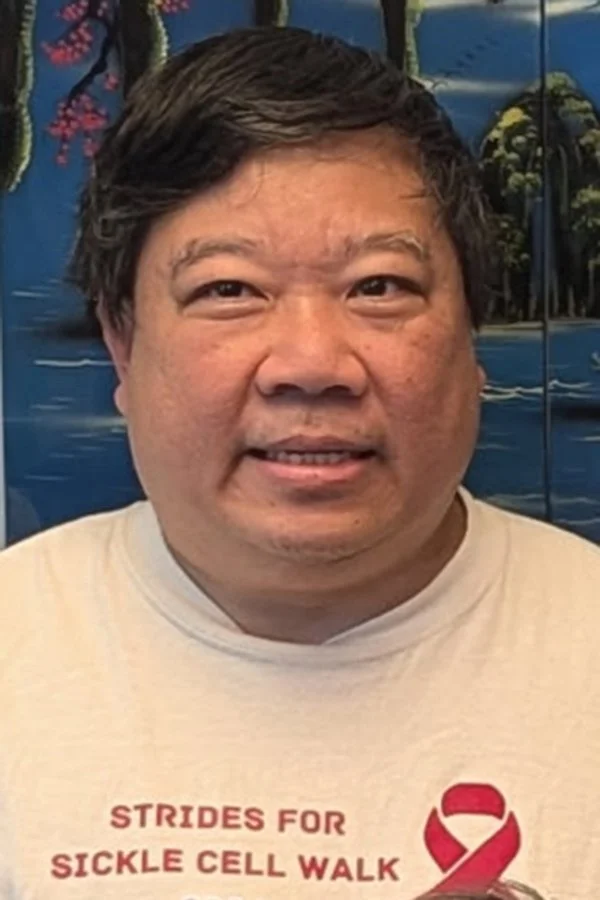
Tung Wynn, MD
This Spotlight appeared in our August 2026 newsletter.
Dr. Tung Wynn is a pediatric hematologist at UF Health Shands Children’s Hospital Hemophilia Treatment Center in Gainesville, FL.
Where do you live? What do you like/dislike about it?
I live in Gainesville, about 20-30 minutes outside the University of Florida and Hospital. I like that it is a quiet small-town neighborhood in Florida, but the things of the big cities – like Disney, Legoland, Busch Gardens, Jacksonville Zoo, the beaches, and even Wild Adventures – are just a couple of hours’ drive away when we want to go. When the students go home in the summer and on holidays, the restaurants and movie theaters have no wait times at all. The disadvantage is I don’t have the wide selection of restaurants; I especially miss having a good Dim sum place, and I can’t grow some of the tropical plants I would like if I lived further south.
What does your family like to do for fun together?
I like to cook for my family whenever I have the time to do it. I love to slow cook barbeque with a smoker, and to make Vietnamese food the way my mother taught me for them to enjoy. At home we spend a lot of time playing board games. Our current favorites being Catan, Splendor, and Dominion.
What is your family’s go-to way to celebrate big moments? Any traditions?
What we do to celebrate is not too special as all we do is have everyone together for dinner, whether that is a potluck at my house, or a meal at BJ’s restaurant or the local Korean Barbeque restaurant. We like to make a big deal of all the special moments whether they are big or small… celebrating even just getting a good grade on a test the kids were really worried about or getting a good report card. My favorite tradition is carving an animal garnish out of fruit for Mother’s Day for my wife every year.
Favorite food? Hobbies? Pets?
My go to comfort food is a Vietnamese dish called “bánh xèo.” It is a like a savory crispy crepe filled with pork, shrimp, onions and bean sprouts served with fresh herbs vegetables and covered in “nước mắm,” a common Vietnamese sauce.
I like to go outside and work in my garden. I grow lemongrass, Asian basil, ginger, and lots of hot peppers to use in my cooking. I like to grow flowers as well and see all the colors just appear out of nowhere all throughout my yard. I am also trying to raise a couple of cherry trees to fruit here in Florida (this is a bit of a challenge because it doesn’t get cold enough for most cherry trees) and a special tropical fruit called a Cherimoya which can’t tolerate any cold at all.
I love dogs, especially lap-sized ones. They are the best for cuddling up on the couch (besides my wife). I’ve owned a couple of cocker spaniels and a beagle mixed breed. I have recently started raising some chickens in my backyard and they have been fun. I also keep a small pond in my garden with fish I’m raising, and I have had a worm farm (they are good at making really rich compost for my garden).
What music do you like to listen to?
I grew up as a child of the 80’s and 90’s so I enjoy most music from those eras. I will listen to whatever is on and don’t pay much attention to it. It’s like the muzak that plays in the background of elevators for me. I have a hard time listening to country music, especially if the “twanging” is really heavy.
If you could vacation anywhere, where would it be and why?
I’ve always wanted to go to Venice to enjoy the canals and see the history and museums there. I’ve also had Australia on my wish list of places to travel to go see some of the unique animals.
You have been on Faculty at our patient conferences since the beginning. What stands out to you about your experience at the conferences?
I have always noticed how well informed all of the conference attendees are. I am also impressed that everyone is welcoming, especially when I see new families come to the conference. Lastly, I’ve enjoyed seeing everyone year after year and getting to know everyone better each time.
What is your funniest memory from a VCF Conference?
My favorite session was when I was able to join the children in their playroom as a time for them to have with me as a physician. You would think they would be curious about their VWD and want to know what I know about it, but it was about their favorite colors and games and movies and TV shows. I loved the fact that they were just kids being kids.
Any thoughts about what the Foundation or the world of severe VWD may look like 10 years from now?
These are very exciting times. I see severe VWD, professionally, being where hemophilia was in the early nineties in terms of therapeutics. There is going to be an abundance of new therapies available that we will have to learn how to best use. With the new choices, the treatments will also get better and more convenient. Ultimately, I see the emergence of a curative therapy, like gene therapy, as I approach the twilight of my career.
You are the lead of the Severe VWD Definition Global Consensus Panel project and just recently presented the results at the ISTH Congress. Could you tell us about that?
I think it is too easy to overlook someone with a severe VWD as “just another patient” with VWD, most of whom experience mild bleeding symptoms. A lot of type 1 patients have the stigma of “do they or don’t they” really have VWD at times. For severe VWD patients, this translates to “do they or don’t they” really have severe bleeding ... or is the bleeding really as bad as they say? Severe VWD is not the same thing as non-severe, just as severe hemophilia is not the same as mild hemophilia, but no severe hemophilia patient ever had to explain himself in this way. Recognizing severe patients as having a different, and more challenging, experience with the disease is the first step in how we can deliver the best care we know for them. We will be better able to get drugs and treatments without weeks and months of delays waiting for approvals and trying to explain what “severe” is to justify the need. I also see that we will be able to more rapidly develop drugs in clinical trials because we will more easily and quickly be able to show how they help. These drugs, once proven effective in severe patients, would benefit and become available to the non-severe VWD population more quickly as well. Severe VWD is the vanguard for the VWD population as a whole.
How do you think this definition will impact patients?
I would like our severe patients to be able to band together as a group and finally have an identity that can be described. I hope that this will allow the professional community to know more and be smarter about the experience of having severe disease. There is no lack of desire to be compassionate from the health care professionals I’ve worked with, but we simply don’t know what we don’t know. Having a definition should allow us to shine a light on it and we will be better able to describe and understand what the experience really is. Sharing this makes empathy and compassion easier and it helps care providers deliver the care that is being asked for. Our patients won’t have to defend or excuse themselves for having the disease that they have. They should not have to be the most knowledgeable person in a room about their disease as often.
Any last thing you would like to share?
I have thoroughly enjoyed being a part of the VWD Connect Foundation and the Severe VWD Conference from it’s outset. Just as much as I’ve heard people say how much it means to them to be there, I have been able to learn and grow just as much from all the attendees as well. •